
Yes, that is a rego plate. Meet the hottest set of road wheels in the land of the Rising Sun.
Story by PETER LYON. Photography by PAUL DEBOIS.
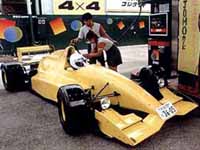 This is a street-legal Reynard F3000 ... on Japanese roads. And I thought Mel Gibson was slightly twisted in Mad Max! I mean, c'mon. I've heard of road-going McLarens, but a street-legal Reynard F3000?
News that a bright yellow streak had been menacing motorists in central Japan was too much to ignore, so I packed my thrill pills and a pinch of curiosity and trundled off down to Nagoya for the day. In a place that's only a stone's throw from Toyota City, your body soon hankers for a quick fix to deaden the boredom of colourless Corollas and sexless Starlets.
I didn't have to wait long for the adrenalin additive to kick in. Just as I was about to lose consciousness watching for the beast to appear in amongst the myriad of melancholy metal, it materialised at the crosswalk in front of my hotel, engine roaring and tyres
smoking. Any four-wheeler stopping at a crosswalk is not normally news worthy, but when that car is a real F3000, and the driver has to wait for a kid and his dog to clear the white stripes, things take on whole new meanings. You begin to think anything's possible.
Four years back Go Ishikawa, the driver with a mission, latched onto the idea of picking up a complete, race-hardened Reynard F3000 and modifying it for road use in Japan. Many a young car nut has dreamed of such lunacy, but Go made it happen. He may be 200 grand lighter for the trouble, but he challenged the realm of sanity in one of the world's most orderly societies, and won.
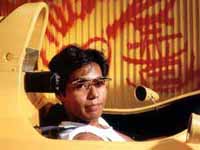 Some say the Germans don't have a sense of humour. Well, until I met Go, I thought the Japanese were a pretty sombre bunch too. Geez, this guy smiles when he says, "I think this is probably the most impractical car in the world, but it was worth every Yen".
Of course, before Go got his hands on it, this lean machine was one of the hot contenders in Japan's F3000 Championship, the series where the likes of Eddie Irvine and Ralph Schumacher learned how to steer. Propelled by a Mugen-Honda 3.0-litre V8 pumping out 395 kW, the 550 kg car can rocket its pilot to 300 clicks in the time it takes Carl Lewis to cover the 100.
Now, Go wanted to leave the car as close to original specs as possible. But before he could do that, he had to satisfy the boys in blue down at the police pits. On the track, the Reynard's carbon fibre monocoque body must be strong enough to absorb minor slips, like hitting concrete walls and the roll hoop has to withstand two tons of pressure.
But to the grease monkeys at the government inspection garage who earn their way prodding and dissecting Corollas for a living, that racing stuff meant zippo. Go had to throw three other bodies at speed against a wall to prove his car's impact absorption strength before he got the green light.
The next hurdle was emissions, of the noise and exhaust variety. To pull his vehicle within legal limits he had to conduct a triple bypass. Out came the raunchy racing V8 and in went a more sedate Nissan 3.0-litre V6 generating around 170 kW. His car may now have eight silencers on it, but the explosion of the engine's well-tuned resonance bouncing off the walls of his garage was pure heaven.
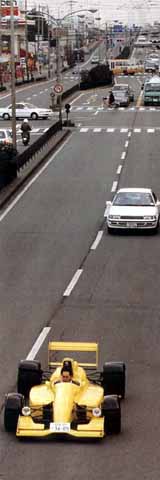 Go may love to tinker, but as far as the rest of the car goes, it's almost untouched. "I raised the body about three centimetres, but the five-speed sequential gearbox and triple-plate racing clutch are the same," he says. Mind you, he's had to stick on the number plates, indicators and brake lights that every man and his dog must wear to get the ultimate thumbs-up. Did pick up one minor technicality, though. Perhaps something the pit bosses missed in the final check. The tyres are F3000 wets and clearly state on the side walls, "For Racing Use Only - Not For Highway Use". But we'll let that one go.
Easy-going Go is surprised more people haven't done this before. "But I think that although Japan has an amazing car industry, it has no car culture. Nobody does what they want with cars here because they're being told what to build by the industry." Go himself is no industry, person. No way. He earns his crust by customising cars, making Minis more mini and has no hesitation in chopping off tops and ripping the guts out of
Rollers or Testarossas to please rich soft-top fanatics with his brand of cosmetic surgery.
"I'm a little un-Japanese in a way ... I never apprenticed with anyone, just taught myself about cars," explains the self-styled mechanic/designer. In fact, that's the very reason he decided to build the street-legal Reynard. "I'm only 27, very young for a garage owner, and in the world of Japanese business, age is everything. The young generally aren't trusted, so I've done this Reynard partly to show what I can do." There must be easier and less expensive ways of getting noticed.
Right, I've seen what you can do mate. Now, how about a quick spin? He twiddled his thumbs, looked up at the sky, then down at his feet, and mumbled something like "that clutch isn't easy and it's pretty tight in there, you know".
He wasn't kidding. I'm lucky I've been staying away from that rich red meat and sticking to a diet of fish and rice, or I'd never have parked my behind in that seat. Getting my legs into the tight footwell was my second major triumph. Go has repositioned the pedals to suit his own driving, and although I could get to all three, it was like dancing the Macarena on a 10 yen coin down there.
Now, what did Go say again? "Revs up to 3000, foot off the clutch and, oops, sheeee-it! You've gotta get that triple plate clutch meeting just right or you're jumpin' all over the damn place. I mean, the gear is either engaged or it's not. You have to be able to find the hairline friction point, keep the revs hovering around 3000, and put one and two together. And I thought the Skyline GT-R clutch was heavy. This mother has a similar tension to pumping around 50 kg on the leg machine at the gym. Try that 100 times a day. Eventually it all came together and I was hurtling down the mountain road heading to infinity and beyond (thanks Buzz - Ed).
The yellow demon may only have a Nissan V6 in it, but the car still goes like the clappers. Weighing only a third of a standard sedan, but with the same power, Go said his bullet covers the quarter mile in just on 11 seconds and shoots from zero to 100 in under five. "But I've only ever timed it once. You know, I've never really given it stick. There's nowhere to do it," he reckons. Fibber. The car may be quick but it stops even quicker. In the same way that the clutch is either engaged or not, the brakes are either gripping or they're not. When they do grip you'd better hope that four-point Sabelt does its job, because our man hasn't touched the brakes.
Go's revised Reynard still runs on the Brembo racing variety with four-pot calipers and 13-inch discs all round. When you do hit the skids, you'd better he sure that you want to stop, because you'll decelerate from 100 to nothing in the length of a cricket pitch. It's like hitting a wall!
Once I'd got the hang of the juice and jam pedals, Go let me try a corner or two. With a lock-to-lock of only 180 degrees, the Reynard's steering is precise. Very precise. It may have a turning radius of a whopping 7.9 metres, but point it into a corner and it goes exactly where you want it to go. All that rubber on the road does make steering a chore, but there is absolutely no play in the steering whatsoever.
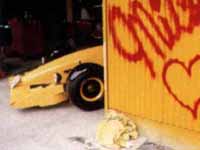 But more mindblowing than the steering was the actual act of cornering. I admit I went gar-gar when I recently drove the NSX type R, with rock hard suspension, but this thing redefines the term body roll. There is none. Even at 100 km/h, the car dares you to gun it more. The F3000 might not he doing much in the corners - apart from holding its line - but the driver certainly is. A nanosecond after you enter a corner, you can feel the Gs playing havoc with your torso and neck especially. You feel as if you're being thrown up and outwards, and the seatbelt is the only lifeline between your cockpit cocoon and a face full of passing pine trees. But don't get me wrong. The Reynard instills nothing but confidence in a driver, because you will always be driving it light years below its limits. Never once did I feel unsafe in it. Complete sensory overload doesn't allow you time to think about anything but keeping the car on the road.
Go was right when he said he hadn't touched the suspension. Just run over a bee's left toenail and your eyeballs bounce. And the view is just like you see on Michael Schumacher's racecam as he nudges Damon Hill from behind. I always wondered how much those guys actually saw from the cockpit. Surprisingly, front and rear visibility is excellent with the mirrors aimed just where you need them. Sometimes, you're glad they are so good, especially when you get a bemused motorist on your tail showing you a little more curiosity than you care for. Just exercise that right foot a smidgen and you're on your own again.
But I am amazed that this thing hasn't caused more accidents. If I had a yen for every time a neck swivelled to check out the rarest four-wheeler of them all, I might he able to buy Go's pride and joy.
After a couple of minutes in the seat, my respect for those F1 pilots jumped to new heights. And they spend two hours every race strapped in, like bugs in a pod. Mew As I handed back Go's helmet and wiped the sweat from my face, I thought, "Girls! Go this thing must get the women in, hey?"
"Oh yeah, sure mate" he replies. "Trouble is, there's nowhere for 'em to sit. Unless perhaps they sit behind me and straddle the engine, but then again, maybe not..."

Comments